Deliver Opportunities for Young People
Scotland once had a world-renowned education system. Under the last Scottish Labour government, the performance of students in maths, literacy and science was among the best in the world. But after 19 years of an SNP Government, this is sadly no longer the case. They have failed to deliver on the promise of excellence in our schools, with Scotland slipping down international standards on the core subjects of reading, maths and science.
Staff in schools are burning out. Many are leaving the profession early and we have a crisis in retention. Workloads have soared and, due to the lack of wider support available for young people outwith school, staff are being forced to plug the gaps. We need to create the environment in schools where teachers can teach and get access to the support their pupils need.
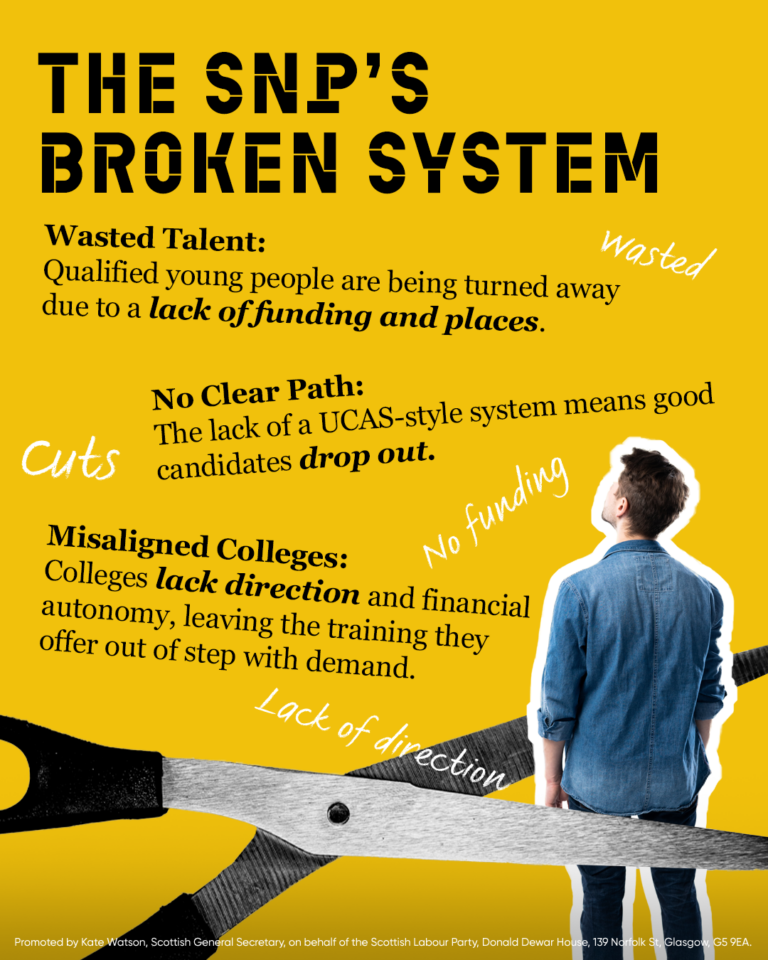
Schools and classrooms should be spaces for learning, growing and flourishing, but in Scotland currently, huge inequalities persist. As many as 1 in 6 young people aged 16-24 in Scotland are not in education, work or training and for those who do not go straight to university the pathways to skills and well-paid work are too narrow. Colleges have been undermined by years of funding cuts and our education system is not well enough connected to the real economy.
Scottish Labour believe in the power of education to change the lives of young people. We will restore excellence and equity to Scotland’s education system so that we can create meaningful opportunities for the next generation.



To Make our Schools Safe Places that Promote Learning, Scottish Labour will:
· Ban mobile phones from classrooms across the country and take a zero-tolerance approach to violence in schools.
· Restore the place of knowledge in the curriculum, raising standards in literacy and numeracy as a priority.
· Establish a national attendance register to monitor absence levels to ensure support and alternative provision is targeted to the right places.
· Embed digital skills and literacy across the curriculum so that young people are prepared for the future.
· Create an online platform to support music tuition and guarantee every child the chance to learn to swim.
Find out more about the SNP’s record of education below:
To Prevent Teacher Burnout and Support our Education Workforce, Scottish Labour will:
· Reduce the bureaucracy and form-filling that teachers are burdened with. Through our curriculum reforms, we will simplify their workload and ensure they can spend their time teaching pupils.
· Give schools security of funding and make Pupil Equity Funding permanent, working with them to deliver PEF for a purpose.
· Create a national register of supply teachers to help teachers find work near them.
· Create a long-term workforce plan for teachers and support assistants so that training places are linked to future jobs.
To Prepare Young People for the World of Work, Scottish Labour will:
· Ensure all young people have access to quality skills and careers advice at school and support schools to build links with local employers and opportunities.
· Deliver a Skills to Schools programme, with certified work experience and industrial work placement for every secondary pupil.
· Establish Scottish Industrial Standards to help create pathways from school subjects to well-paid and skilled work in key growth sectors.
· Create a digital skills passport, with a record of every individual’s qualifications, skills and achievements to provide clarity to employers and workers and to ensure the value of work experience and technical and vocational training is recognised.
Read more in our Green Paper for Skills.
To Help Young People Find Opportunities After School, Scottish Labour will:
· Maintain free university tuition for Scottish students and work with the higher education sector to find a funding model that ensures the long-term sustainability for the sector.
· Guarantee a place for every qualified apprenticeship applicant in key industries with 9,000 new apprenticeship places.
· Create clearing systems for apprenticeships, learning from UCAS, to help young people find alternative opportunities within their chosen industry if they miss out on their first choice.
· Reform college funding so that it is aligned with local skills need, industrial strategy, and employment outcomes.
· Expand the Graduate Apprenticeship offer so that it is promoted as a valid choice for those at the beginning of their careers and those considering what to do following school.